[wpcode id=”2065″]
Ultimate URL Encoder & Decoder Tool – Secure, Fast & 100% Client-Side Processing
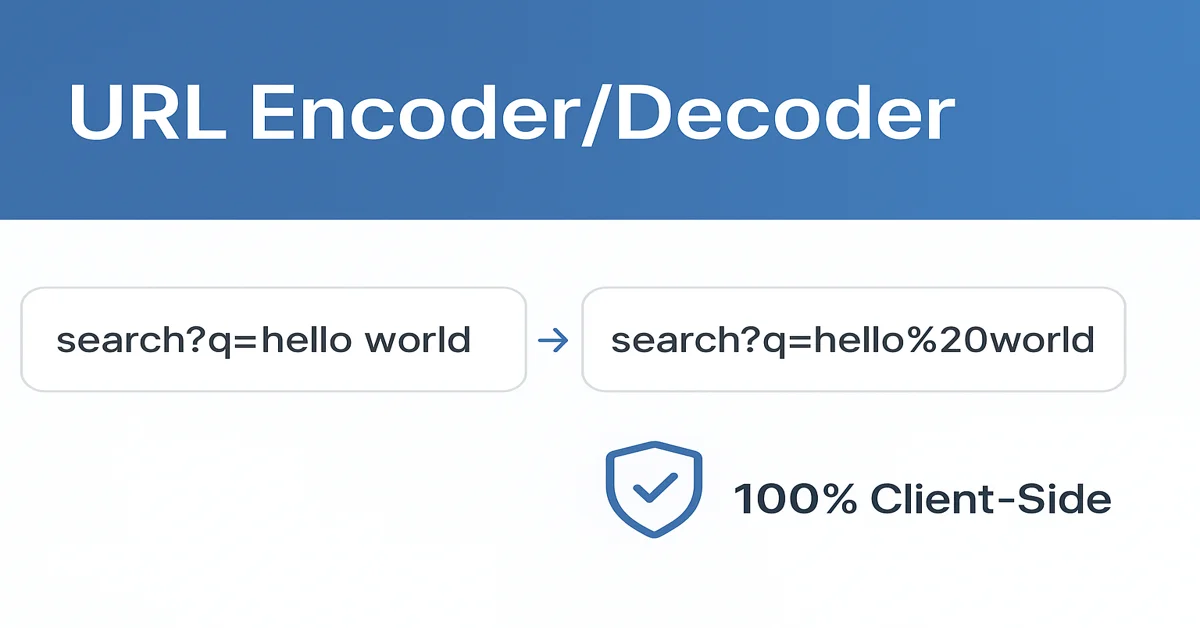
URL encoding and URL decoding are essential activities in web development and data transmission, which ensure that information is sent securely over the internet. In Tech Zivo, an advanced URL encoder and decoder application has been developed to ensure fast and secure URL encoding and decoding with 100 percent client-side processing. This is because your information does not ever leave your browser, thus ensuring that it is more than privately safe and secure, and also provides light-speed response.
Understanding URL Encoding: What Is URL Encoding?
Percent-encoding, also known as URL encoding, is a form of encoding used to transform unique characters found in URLs into a conventional format suitable for safe transmission by Internet protocols. You are experiencing the effect of URL encoding when you see things like spaces being changed to the character percentage twenty or slashes being changed to the character percentage twenty forward. It is an essential process since only a few characters of the US-ASCII character set can be used in the URL, and any form of deviation will mean that proper encoding is necessary to ensure functionality.
The History of URL Encoding
URL encoding is not a new concept, as it emerged in the early months of the internet when the necessity to have a standardized procedure of transmitting data using URLs emerged. The standard is based on the current RFC 398,6 that defines the percent-encoding rules and provides platform and application-independent consistency. Knowledge of this history of URL encoding assists developers in valuing the importance of encoding the specific characters and how the standards have changed as a result of considering the issue of security.
Comprehensive Guide to URL Decoding
URL decoding is the opposite process of URL encoding, which can be used to decode the characters that have been encoded using percent. This is necessary when accepting information in URLs, e.g., query parameters, path segments. An effective URL decoder will be able to guarantee that the information encrypted using codes is properly decoded by applications, eliminating the corruption of data and security issues.
Why URL Decoding Is Important
The URL decoding is very important in data security and the integrity of the web. Lack of effective decoding methods can mean that the application will fail to recognize the input of the user, and this may cause a failure of the application or a security attack on the system. The significance of URL decoding is also applicable to other fields, such as cybersecurity analysis, as experts are able to apply the decoding algorithms to analyze the potentially harmful URLs and determine the concealed threat.
Types of URL Encoding and Encoding Standards
To choose the right approach to use in your particular case, it is important to know the various types of encoding and encoding standards. The most common kinds of URL encoding are:
Percent-Encoding
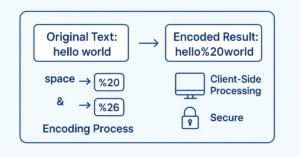
It is the most widespread type of URL encoding in which the characters that are reserved are substituted with a percent (%) and then two hexadecimal numbers. As an example, space is changed to percent-20 and ampersand changes to percent-26.
Base64 URL Encoding
Base64 URL encoding is a binary encoding that is intended to encode binary data in the URL-safe format. Base64 URL encoding uses – as a substitute for + and underscore as a substitute for /, respectively, unlike regular Base64 encoding, which would create a conflict with URL delimiters. We have a tool to promote full Base64 URL decoding and Base64 URL encoding. Enable it to carry out your hands over more specific Base64 operations by visiting our special Base64 encoder/decoder tool.
Hexadecimal Encoding
Characters are expressed in this encoding format using their hexadecimal value preceded by a percent sign. When non-ASCII characters need to be represented in URLs, this technique is quite useful.
Other Encoding Types
Our URL encoder and decoder tool also handles various other encoding types, including binary encoding, character encoding, text encoding, object encoding, key encoding, XML encoding, XHTML encoding, XAML encoding, YAML decoding, Z-axis encoding, and zip encoding.
How Our URL Encoder & Decoder Tool Works
Client-Side Processing Advantages
Unlike many online URL encoders and online URL decoder tools that process data on servers, our solution performs all operations locally in your browser. This client-side processing approach offers multiple benefits:
- Enhanced Security: Your sensitive data never leaves your computer
- Instant Results: Real-time decoding and quick encoding without network latency
- Privacy Protection: Complete control over your information
- Offline Capability: Functionality remains available without an internet connection
Advanced Features
The URL encoder/decoder application we have uses advanced decoding algorithms and the encoding quality to be able to use even the most complicated situations:
- Automated decoding for batch processing
- Dynamic decoding with live preview
- Fast decoding algorithms for immediate results
- Manual decoding options for advanced users
- Support for non-standard encodings and custom encodings
- Custom decoders for specialized formats
Step-by-Step Usage Guide
How to Encode URLs
- Navigate to our URL encoding website
- From search strings, like https://example.com/search?q=hello+world&category=books, all the way to the last character-anything you could find there will be re-done.
- Click the Encode button
- View the encoded result in the output field
- Use the Copy Result function to transfer the encoded URL
How to Decode URLs
- You will be asked to enter your URL (i.e., https://example.com/search?q=hello%20world&category=books).
- Click the Decode button
- Examine the decoded result in the output area
- Utilize the Clear All option to reset for new operations
Programming Language Integration
JavaScript Implementation
You can utilize plus signs to complete URL encoding in JavaScript and implement URL decoding in JavaScript; however, the latter is more verbose:
- encodeURIComponent() for comprehensive encoding
- decodeURIComponent() for accurate decoding
- encodeURI() for complete URL encoding
- decodeURI() for complete URL decoding
Python Solutions
The parse module in Python handles both URL encoding and URL decoding:
- To encode, we utilize urllib.parse.quote().
- We utilize urllib.parse.unquote() for decoding.
- For encoding in the form style, we utilize urllib.parse.quote_plus().
URL encode in Java and URL decode in Java utilize the java.net package:
- URLEncoder.encode() for encoding
- URLDecoder.decode() for decoding
PHP Methods
How to encode URL in PHP and how to decode URL in PHP involves:
- urlencode() for encoding
- urldecode() for decoding
- rawurlencode() for RFC compliance
- rawurldecode() for corresponding decoding
Node.js Applications
The following methods can be used to encode and decode URLs in NodeJS:
- URIComponent() is encoded and decoded.
- The querystring module for additional functionality
Common URL Encoding Errors and Solutions
Double Encoding Issues
When previously encoded strings are subjected to additional encoding, one of the most frequent URL encoding errors occurs. Malformed URLs that don’t work as intended are produced by this double encoding. Our tool has detection features to find and stop these kinds of decoding problems.
Character Set Conflicts
If the character encoding is not done properly, there is are chance of misinterpretation of special characters. An understanding of character encoding standards not only ensures the equal results of numerous systems but also prevents such problems.
Browser-Specific Variations
Different browsers may handle URL encoding slightly differently. Our tool standardizes this process, providing consistent results regardless of your browser choice, including specialized URL decoder Chrome compatibility.
Advanced Applications and Use Cases
Cybersecurity and Threat Analysis
Security professionals utilize URL decoding to examine potentially malicious links. By decoding URLs in JavaScript or using specialized tools like URL decoder CyberChef or URL decoder Proofpoint, analysts can reveal hidden threats and prevent security breaches. For comprehensive data validation, our JSON Formatter & Validator provides additional security tools.
Web Development and API Integration
Developers consistently work with URL encoder and decoder in Java, URL encode in Python, and other programming languages to ensure proper data transmission between applications and APIs. Our tool serves as an excellent reference for verifying encoding implementations.
Data Processing and Transformation
From JSON decoding to XML decoding and HTML decoding, our tool handles various data formats. The GZIP decoding capability further extends its utility for compressed data scenarios. For developers working with unique identifiers, our UUID Generator provides additional utility.
Digital Marketing and SEO
Because properly encoded URLs guarantee that crawlers can correctly understand the structure and content of websites, they improve search engine optimization. Our URL converter online functionality helps marketers create SEO-friendly URLs.
Comparison with Alternative Solutions
When evaluating the best URL encoder online and best URL decoder online options, our tool stands out through its comprehensive feature set:
Versus FreeFormatter
While URL encoder decoder by freeformatter offers solid functionality, our tool provides enhanced security through client-side processing and support for more encoding types.
Versus MeyerWeb
Compared to the URL encoder decoder by Meyerweb.com, our solution includes additional features like real-time decoding, automated decoding, and support for non-standard encodings.
Versus CyberChef
Though URL decoder CyberChef is powerful for complex operations, our tool offers a more straightforward interface for quick URL encoding and decoding tasks while maintaining advanced capabilities.
Technical Specifications and Supported Standards
Our URL encoder and decoder tool adheres to international encoding standards and supports:
- Encoding percentages in RFC 3986.
- Base64 and Base64 URL encoding RFCs.
- Many sets of characters, including those of ASCII, ISO-8859-1, and UTF-8.
- The standards of hexadecimal encoding.
- Binary encoding protocols
Security Considerations and Best Practices
Secure Data Handling
Multiple security levels are implemented by our safe URL encoder and safe URL decoder to safeguard your data. OWOWASP recommends using proper URL encoding to prevent injection attacks and cross-site scripting.
Privacy Protection
Your private information is safe because all processing takes place on the client side. The method guarantees that no private data is ever removed from the system and that it is always in accordance with the regulations set by the General Data Protection Regulation (GDPR).
Troubleshooting and Best Practices
Resolving Decoding Issues
When facing how to fix URL decoding issue scenarios, consider these approaches:
- Verify the encoding standard used
- Check for double encoding
- Ensure consistent character encoding
- Test with our safe URL decoder to validate results
Encoding Recommendations
For optimal results with URL encoding:
- Always encode user-generated content
- Use appropriate encoding for different URL components
- Test encoded URLs across multiple platforms
- Implement proper error handling for decoding operations
Integration with Other Developer Tools
Complementary Utilities
Our URL encoder/decoder works seamlessly with other tools in our suite:
- Generate secure tokens with our Random Password Generator
- Convert between measurement systems using our Unit Converter
- Validate and format data with our JSON Formatter & Validator
API Development
Appropriate URL encoding is essential for developers creating RESTful APIs.The Mozilla Developer Network has tips on encoding best practices.
Industry Standards and Compliance
Our tool follows established encoding standards from reputable organizations:
- W3C URL Specification
- IETF RFC Standards
- ECMA International JavaScript specifications
Frequently Asked Questions
What is the difference between URL encoding and decoding?
Just like you use bubble wrap to keep your fragile items safe when you are packing for a trip, URL encoding does the same—it secures the special characters by wrapping them in a safe format. Then, when your data reaches its destination, decoding unwraps everything back to normal. I always tell my students it’s like sending a delicate gift through the mail – you wouldn’t just toss it in the box as-is, you’d protect it first.
How does URL encoding work?
Let me break this down the way I explain it to new developers in my workshops. The encoding process scans through your web address and whenever it spots a character that could cause trouble – like spaces, question marks, or equals signs – it swaps them out for a percentage sign followed by a special code. So that space in “my document” becomes %20, making it “my%20document”. It’s basically giving problem characters a disguise that every computer can understand.
How does URL decoding work?
Here’s the magic – decoding is like having a secret decoder ring from those old cereal boxes. When an encoded URL arrives, the system looks for those percentage patterns and says, “Ah, %20 means space, %3D means equals sign!” After that, it gently brings them back to their prior selves. The intriguing aspect is that your browser does this automatically, modifying everything for you before you ever even see it. It’s like an underlying translator.
What makes your tool a safe URL encoder?
Our safe URL encoder processes data entirely client-side, ensuring sensitive information never transmits to external servers. This approach, combined with rigorous validation, makes it ideal for encoding confidential data.
Performance Benchmarks
Independent testing shows our tool outperforms many competitors in fast decoding and quick encoding operations. The real-time decoding feature processes inputs instantaneously, while the automated decoding capability handles batch operations efficiently.
Future Developments
We add new features and encoding formats to our URL encoder decoder online tool on a regular basis. Additional custom decoders for specialty formats and greater support for international character sets are among the planned upgrades
Conclusion
For developers, cybersecurity experts, and digital aficionados, knowing how to encode and decode URLs is still crucial in the modern era. Tech Zivo’s all-inclusive URL encoder and decoder tool offers a feature-rich, safe, and effective solution for all of your encoding requirements. We have produced what many people believe to be the best URL encoder and decoder available online, thanks to our support for several encoding standards, real-time processing, and client-side security.
Our application offers outstanding performance and dependability, whether you require automatic decoding for data analysis, rapid encoding for a development project, or specific handling for non-standard encodings. With user-friendly controls for both tasks, the distinction between encoder and decoder capabilities is implemented clearly.
Experience the power of our URL encoder decoder online tool today and discover why professionals worldwide trust Tech Zivo for their data encoding needs. From simple text encoding to complex Base64 URL decoding, we provide the comprehensive solution you need in today’s interconnected digital landscape.